National Consortium for Languages Education
UCL Institute of Education

NCLE Symposium: AI and Languages Education
How can we best harness the capabilities of AI tools while retaining the specific strengths and advantages of human-mediated approaches?
NCLE was delighted to host an AI Symposium in November 2025, bringing together researchers, experts, and practitioners with an interest in the role of artificial intelligence in language education.
The symposium provided an opportunity to explore state-of-the-art evidence from research and practice on the use of AI in language education, with a particular focus on how emerging technologies can inform policy development, teaching practice, and future research agendas.

Scroll down for:
- Information on all 10 AI Symposium presentations, including access to the recording and downloadable PowerPoint slides for each session.
- Reading list on AI and Language Education
To help guide you, sessions have labelled with the following categories: Big picture; Teacher agency & pedagogy; EdTech use & design; Pedagogical principles; Assessment; and Practical demo.
The sessions from NCLE’s AI Symposium provide the latest research insights and analysis on:
- The ethical and philosophical questions we must ask ourselves as we embark on an AI-assisted future for languages education.
- The nature of AI and the impact of its interaction with the psychology, cognition and pedagogy of human teachers and learners.
- The extent to which AI outputs enhance and/or diminish the effectiveness of learning and assessment, with specific implications for Ed Tech design, inter-disciplinary collaboration in research and development of AI tools, and teachers’ and learners’ deployment of these tools.
- How AI is changing traditional and expected roles of teachers and learners, and the mechanisms by which AI, teachers and learners mediate teaching, learning and assessment.
- Practical demonstrations for teachers in how to deploy free AI tools to generate teaching materials and enhance lessons, with a focus on data protection, reliability, bias, safeguarding and managing the potential impact of relying on AI tools for fundamental pedagogical principles.
‘It is necessary to lift the lid on AI’s capabilities and delineate the distinctive qualities of human- and algorithmically-mediated pedagogy’
(Pachler and Turvey).
NCLE: Providing research informed insights into language teaching and learning – leveraging UCL Institute of Education’s world-leading research base.
Guest speakers
- Professor Mutlu Cukurova, UCL Institute of Education
- Dr Kevin Tai, The University of Hong Kong
- Seongyong Lee, University of Nottingham Ningbo China
- Associate Professor Vahid Aryadoust, NTU Singapore
- Professor Christine Goh, NTU Singapore
- Professor Mary Richardson, UCL Institute of Education
- Dr Catarina Correia, UCL Institute of Education
- Dr Nick Wong, The Hong Kong University of Science and Technology
- Dr David Dai, UCL Institute of Education
- Professor Zhu Hua, UCL Institute of Education
- Yunan Zhang, The University of Hong Kong
- Professor Yongcan Liu, University of Cambridge
- Joe Dale, Independent consultant
- Jérôme Nogues, UCL Institute of Education
- Professor Norbert Pachler, UCL Institute of Education
- Dr Keith Turvey, UCL Institute of Education
AI Symposium Presentations and Resources
A Framework for Teacher-AI complementarity
Professor Mutlu Cukurova (UCL Institute of Education)
Now that AI demonstrably outperforms humans in many tasks across a widening set of benchmarks, we face some fundamental questions: What do we risk losing if we offload tasks to AI? What is acceptable? Teachers are using AI to save time on tasks, but do we risk ‘cognitive atrophy’ the more we do this? Prof Cukurova explores models of human-AI teaming which could provide a future roadmap, while considering the difficulty of achieving genuine human-AI synergy, and what this means for researchers and practitioners as AI is increasingly integrated into languages education.
- Big picture
- Teacher agency & pedagogy
Key words: Teacher-AI complementarity; Cognitive atrophy; Replacement paradigm; Synergistic teaming; Teacher agency
Translanguaging and AI
Dr Kevin Tai (Hong Kong University) and Seongyong Lee (University of Nottingham Ningbo China)
Generative AI has great potential for supporting multilingual learners in contexts around the world but evidence shows it struggles with translanguaging as AI responds based on statistical probability which can reinforce standardised (dominant) language and societal biases. Despite integrating external data and advanced prompt engineering techniques, GenAI tools tend to default to standard language norms over time. Can we design an ‘AI-mediated translanguaging space’ that genuinely empowers multilingual students, or will the technology simply replicate the inequities it has the potential to overcome?
- EdTech use & design
- Pedagogical principles
Key words: Translanguaging; Algorithmic standardisation; Linguistic diversity; Stochastic parrot; AI-mediated translanguaging space; Funds of knowledge.
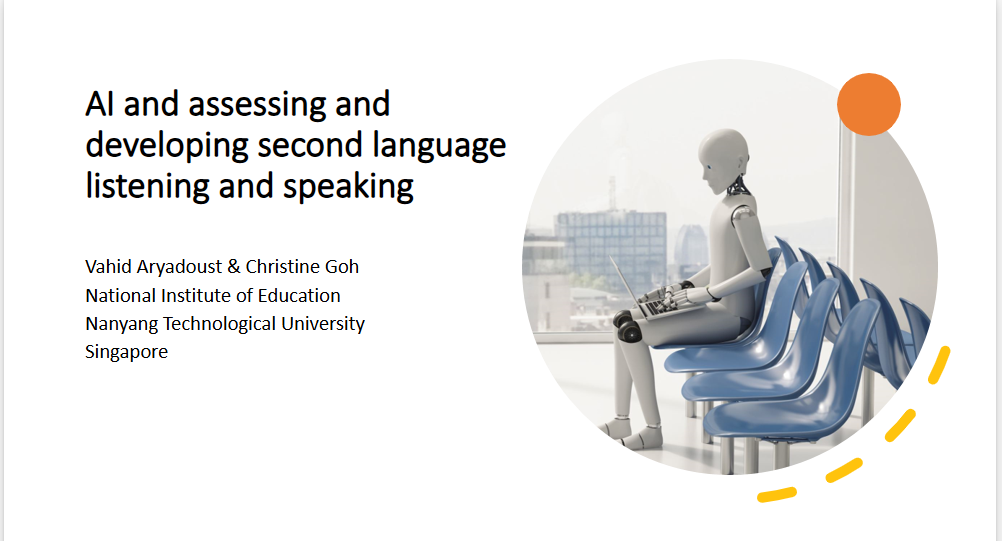
AI and assessing and developing second language listening and speaking
Associate Professor Vahid Aryadoust and Professor Christine Goh (Nanyang Technological University)
AI presents new ways of supporting teachers and motivating students for listening and speaking in the classroom. However, it is important to focus on first principles and know exactly what it is we are teaching and assessing. Is student engagement the same as actual linguistic development? Is AI generating talk or helping learners to learn to talk? Teachers’ knowledge remains key to the process and they must develop their ’fine tuning’ skills. The researchers also consider the importance of learner metacognition and AI literacy to ensure students are engaged and can self-regulate.
- EdTech use & design
- Pedagogical principles
- Teacher agency & pedagogy
- Assessment
Key words: Fine-tuning; Spoken dialogue systems; L2 listening and speaking; Psychometric validation; Learner metacognition; Generating talk vs. learning to talk.
AI and assessment and feedback in foreign language education
Professor Mary Richardson and Dr Catarina Correia (UCL Institute of Education)
AI has collapsed the traditional distinction between assessor and instrument, becoming both simultaneously, and this carries serious implications for the teacher and their role. The authors’ qualitative research into candidates’ experience of the PTE Academic test (a high-stakes, AI-led English proficiency exam) reveals that many candidates believed AI scoring was fairer than human marking, even though AI is demonstrably biased. While trust in AI assessment is increasing, a human must remain in the loop, particularly where assessment outcomes are life-changing.
- Big picture
- Teacher agency & pedagogy
- Pedagogical principles
- Assessment
Key words: Assessment; High-stakes testing; Candidate experience; AI bias; Human–in–the–loop; Assessment and digital literacy.
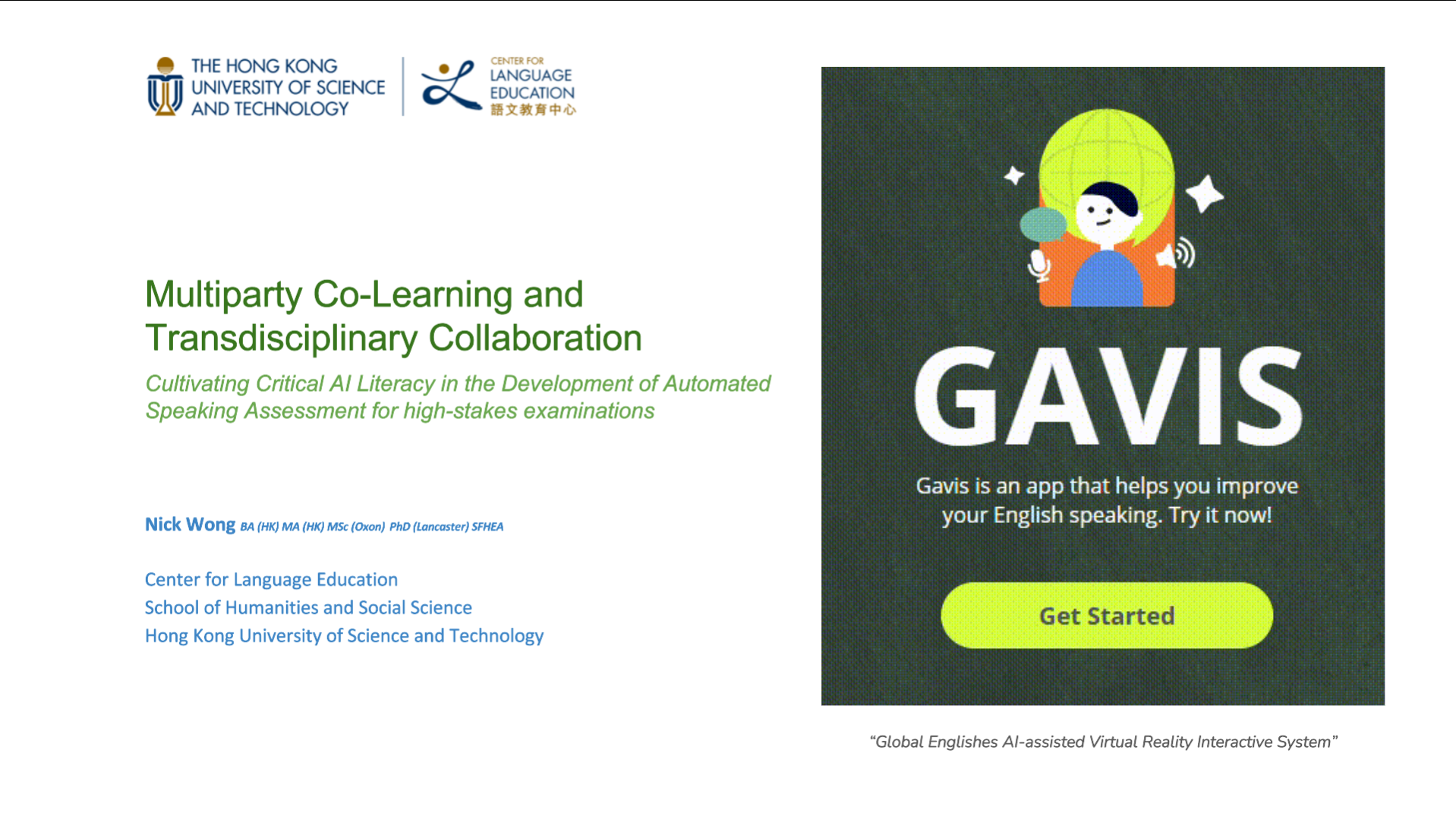
Multiparty Co-Learning and Transdisciplinary Collaboration: Cultivating Critical AI Literacy in the Development of Automated High-Stakes Speaking Assessment
Dr Nick Wong (The Hong Kong University of Science and Technology)
GAVIS is a government-funded AI speaking assessment tool for Hong Kong’s high-stakes HKDSE secondary school examinations. Getting the AI to replicate human judgment persistently failed due to AI and humans approaching assessment in fundamentally different ways. A breakthrough was reached with a sequential pipeline mimicking the order in which human examiners assess which required team members to think and act beyond their traditional roles in a trans-disciplinary approach. This session maps out the specific concepts and trajectory of this project as a model for successful, sustainable AI-enabled assessment development in this field.
- EdTech use & design
- Assessment
Key words: AI-assisted speaking assessment; Sequential pipeline architecture; Transpositioning; Multi-to-trans-disciplinary collaboration; Human-in-the-loop; Critical AI literacy.
Generative AI as conversational partner: Developing Critical Interactional Competence in language and culture learning
Dr David Dai and Professor Zhu Hua (UCL Institute of Education)
Using GenAI to practise language and cultural learning comes with risks. Analysing data from a physiotherapist using ChatGPT to roleplay interactions with patients from different cultural backgrounds, research findings reveal how AI produces stereotypical, essentialised cultural representations while engaging in sycophantic agreement with the user. Meanwhile, the user reacts differently to the AI precisely because they know it is not a human. This poses some fundamental questions about learner psychology, agency and the nature of the intercultural dimension in AI-modulated learning environments. The researchers introduce the concept of Critical Interactional Competence (CritIC) as a necessary skill: the ability to engage reflexively and critically within the interaction itself, drawing on their own lived experiences and subjectivities.
- Big picture
- EdTech use & design
- Pedagogical principles
Key words: Intercultural competence; Critical Interactional Competence (CritIC); Generative AI; Cultural stereotyping; Language and cultural learning; Interaction analysis.
The Principles of Strategic Integration of ChatGPT into Foreign Language Writing: Mediation, Design, and Guidelines
Yunan Zhang (Hong Kong University) and Prof Yongcan Liu (University of Cambridge)
How do we tame the AI ‘beast’ in language education? How do we strategically integrate AI into foreign language writing without simply letting it take over? Do learners and teachers have the same goals? Working with EFL students to identify real tensions and contradictions arising in AI-assisted writing, the researchers draw on sociocultural and activity theory and design-based research to move beyond task-level tips and develop a set of empirically grounded principles and strategies. The goal is orchestration: ensuring learners remain in control and deploying the right tools at the right stage.
- Teacher agency & pedagogy
- EdTech use & design
- Pedagogical principles
Key words: AI-assisted writing; Design principles; Sociocultural and Activity Theory; Design-based research; Orchestration.
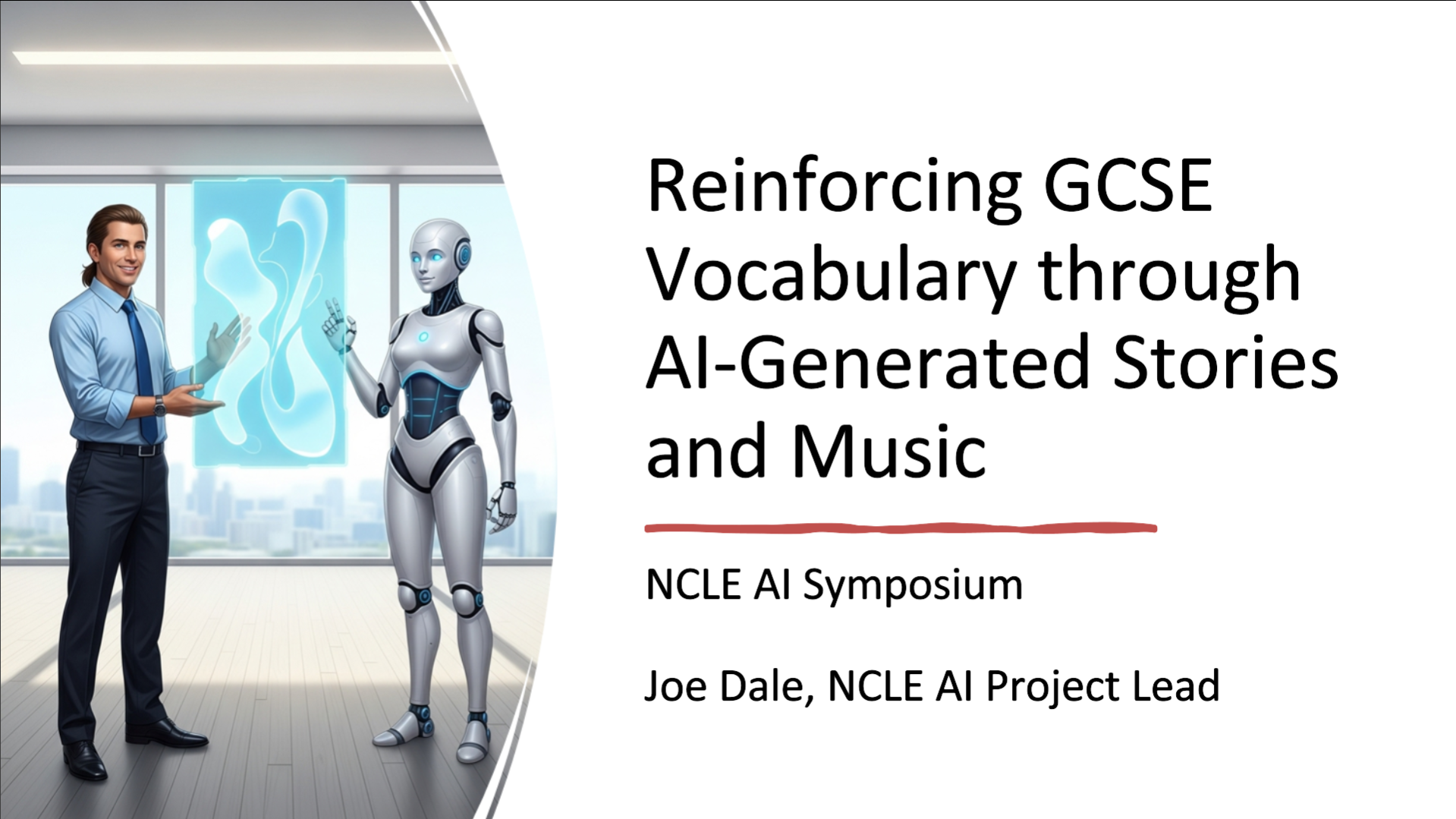
Reinforcing GCSE Vocabulary through AI-generated stories and music
Joe Dale (Independent Consultant)
AI can now do in minutes what once took hours: turn a GCSE vocabulary list into an illustrated storybook, a reading resource, and an original song. But how do we pay attention to vocabulary alignment, GDPR compliance, cultural bias, and age-appropriate tool selection? Watch a real time demonstration of using AI to create a bespoke animated storybook from scratch, aligned to exam board vocabulary lists – using tools which are mostly free and requiring no special technical knowledge. Joe Dale walks us through specific tools and workflows (ChatGPT, MultilingProfiler, Gemini Storybook, PDFGear, Suno); the pedagogical rationale (retrieval practice, pronunciation, meaning and context); and key questions raised in the Q&A around cultural bias, GDPR compliance, and safeguarding.
- Practical demo
- Teacher agency & pedagogy
- Pedagogical principles
Key words: GCSE vocabulary; AI resource creation; Storybook generation; Retrieval practice; Workflow tools; Curriculum alignment.
Reading Between the (AI‑Generated) Lines: Using NotebookLM in Language Learning
Jérôme Nogues (UCL Institute of Education)
Google’s NotebookLM AI tool is especially well suited to teachers due to being free and ‘fenced’ (i.e. only generating outputs from resources uploaded by the teacher, which greatly reduces the risk of hallucinations and every output is traceable to a user-uploaded document). Demonstrated through A-level French resources and the film La Haine, this talk showcases four modes in which to deploy NotebookLM (tutor, quizmaster, storyteller, organiser of thought); and key types of output including audio and video overviews, mind maps, flashcards, infographics, AI-generated slide decks and interactive quizzes. The session also explores the risks of overreliance on AI tools for their speed and efficiency: might this lead us to stop thinking altogether? The session makes the case for teaching AI literacy explicitly to both teachers and pupils.
- Practical demo
- Teacher agency & pedagogy
- Pedagogical principles
- Big picture
Key words: Source-grounded AI; Cognitive offloading; AI literacy; A-level language learning; Multimodality.
Delineating algorithmically mediated and human-mediated pedagogy (inc. lesson planning)
Professor Norbert Pachler and Dr Keith Turvey (UCL Institute of Education)
Drawing on their recent paper in the British Journal of Educational Technology and referring to the presentations in this Symposium, UCL Institute of Education’s Prof Norbert Pachler and Dr Keith Turvey discuss the implications of using AI on pedagogy and the describable risk to human teacher agency.
AI is redistributing agency across political, commercial, and algorithmic mediators. By nature, it goes beyond simply simulating (imitating) a function – it actively seeks to emulate i.e. replace functions. We can train it, but in doing so we also adapt to what it demands from us in a two-way convergence.
Using lesson planning as a specific, research-grounded case study, this session asks: what is lost when intellectual and cultural labour is delegated? Does AI have the capacity to ‘mean’ anything at all? We should not be afraid to ‘lift the lid’ on assumptions about what AI’s capabilities are, and delineate the distinctive qualities of human- and algorithmically-mediated pedagogy. This has fundamental implications for teacher professional development.
- Big picture
- Teacher agency & pedagogy
- Pedagogical principles
Key words: Teacher agency; Algorithmically mediated pedagogy; Lesson planning; Emulation vs simulation; Platformisation; Teacher professional development.
Reading list: AI and Language Education
Curated by Prof Norbert Pachler, Professor of Education and Vice-Dean: Enterprise at UCL Institute of Education, and Chair of NCLE Governance Board.