
Blog: From Cultural Curiosity to Meaningful Connection: Designing Intercultural Language Projects in Schools
On 22 June 2026, NCLE brought together language teachers, from both primary and secondary schools around the country, and researchers from UCL Institute of Education for an NCLE Partnership Development and Co-creation Event to support schools to develop their proposals for National Priority Projects (NPPs) under the theme of Amplifying Intercultural Learning.
The day combined research-informed inputs, practical case studies, panel discussions and collaborative design workshops, which offered powerful insights for schools translating the ideas into projects suitable for their school contexts in the next academic year.
Reframing Language Learning: A Transformative Vision
Professor Zhu Hua (NCLE’s Director of Research and Innovation) opened the day by positioning intercultural learning as central to the future of language education. Drawing on the NCLE vision for language teaching, she emphasised that the curriculum should act as both a “mirror” and a “window”—reflecting and reshaping learners’ identities while connecting them to the wider world.
She reframed intercultural learning not as an add-on, but as a transformative process—equipping learners to navigate cultural and linguistic diversity and develop new perspectives.
The key message to schools is this: Intercultural understanding is not a ‘topic to be covered’, it is a principle that should shape curriculum design and pedagogy across Key Stages.
What Does Intercultural Learning Look Like in Practice?
In the opening session, we heard from speakers who were able to bring research-informed ideas to life through real-life examples. First, Dr Jason Anderson (University of Warwick) demonstrated how project-based learning (PBL) can underpin intercultural initiatives. His model of a flexible six-stage project cycle supports both teacher-led and learner-led enquiry, allowing projects to evolve in response to student ideas. More examples from his work can be found in his new book and to the slides here.
He recommends that schools design projects that:
- – Are problem-driven, not just topic-driven
- – Include authentic collaboration, ideally across contexts
- – Allow student agency in shaping outcomes
Jason’s presentation recording can be viewed here.
Creative Translation: Embedding Culture in Language
Next, Dr Charlotte Ryland (Queen’s College Translation Exchange / Stephen Spender Trust) presented her work on creative translation in schools. Her “decode–translate–create” model transforms translation into an active, intercultural process in which students engage with cultural contexts, meaning and perspectives behind texts, while opening discussions around identity, history and culture.
Evidence from research highlights increased motivation, metalinguistic awareness and intercultural understanding, alongside strong student engagement.
This approach is particularly effective when teachers;
- Use texts as entry points to cultural dialogue, not just comprehension tasks
- Design activities where students create meaning, not just reproduce it
- Integrate intercultural learning into existing curriculum content
Charlotte’s slides can be seen in full below:
Translanguaging and Multilingual Classrooms
Dr Salvatore Giuffrè (University of Thessaly) joined us remotely to share examples from his teaching practice, teaching Chinese in multilingual contexts.
His work showed how learners draw on their full linguistic repertoires to:
- – Reduce cognitive load
- – Enhance cultural engagement
- – Strengthen identity
Examples of cross-linguistic comparison (e.g. structures for “with” or continuous tense across languages) illustrated how learners develop metalinguistic awareness and intercultural insight simultaneously.
A lively discussion followed his presentation and the consensus in the room was that for the translanguaging approach to work, teachers must:
- Treat multilingualism as an asset, not a barrier
- Build tasks that encourage comparison across languages
- Recognise that intercultural learning often begins with valuing learners’ own linguistic identities
Salvatore’s slides can be seen in full below:
Salvatore’s presentation recording can be viewed here.
From Creativity to Critical Interculturality
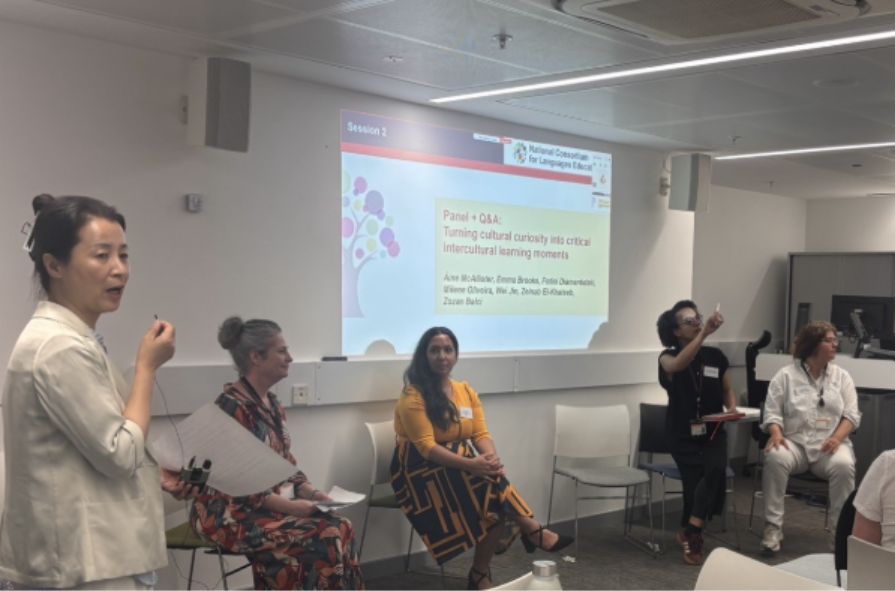
The second session ‘Turning cultural curiosity into critical intercultural learning moments’ expanded the conversation through three sub-panels brought to us by IoE researchers.
- Creative and Participatory Methodologies
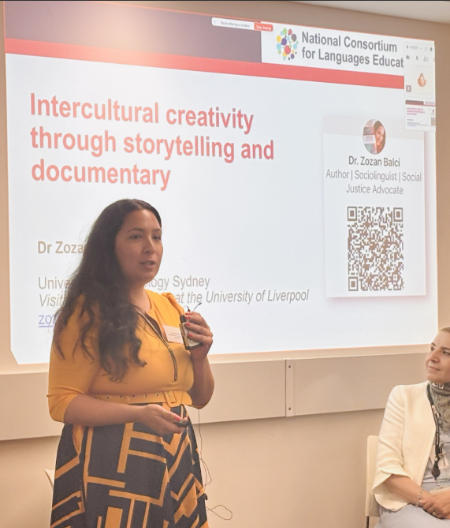
First, Dr Zozan Balci and Áine McAllister highlighted the importance of storytelling, poetry and identity. Balci’s Say Our Names project showed how something as simple as correctly pronouncing a name can create powerful moments of inclusion, reminding teachers that intercultural learning starts with everyday classroom practice. McAllister’s work on collaborative poetic autoethnography demonstrated how learners’ reflections on their own intercultural experiences and languages can drive creative meaning-making practices beyond institutional boundaries and build a pedagogy of trust and care.
- Language Learning, Heritage, and Intercultural Education
In this sub-panel, three academics collaborated to bring teachers’ examples of their work with schools.
Wei Jin’s presentation on the Year 9 Immersive trip as part of the Mandarin Excellence Programme illustrated the scale and impact of international experiences, with over 1,100 students participating in study visits to China, combining language, culture and real-world interaction.
Dr Emma Brooks’ case study of the Welsh School London showed how heritage language education builds identity, community and belonging, encapsulated in the concept of hiraeth.
Zeinab El‑Khateeb’s presentation on “Sustainability, Cultural Awareness, and Outdoor Language Learning”) foregrounded learning beyond the classroom and the role of environment, place and sustainability in shaping intercultural understanding.
- Digital Collaboration and Virtual Exchange
Finally, we heard from Dr Fotini Diamantidaki and Dr Milene Oliveira real-life examples of how technology can enable intercultural dialogue. Their COIL (Collaborative Online International Learning) projects connected students across countries to co-create multilingual artefacts and engage in shared inquiry. Student feedback shows the impact of this:
“People can understand each other even if they don’t speak the same language”
“It helped me break stereotypes”
For a deeper understanding of the research presented by speakers in the sub-panel, please see the slides here.
Takeaways for teachers from these rich sub-panels were:
- The possibilities and impact of extending learning beyond the classroom, connecting language learning to identity and belonging and building continuity between school and lived experience.
- Ideas for using digital tools to create sustained intercultural exchange with project design that allows for maximum collaboration and co-creation, not one-off contact or information exchange.
What Makes a Good School-led Project?
The panel discussion featuring NCLE directors Bernardette Holmes, Zhu Hua, and Norbert Pachler, the DfE Language Policy adviser, Gillian Machin, Headteacher Jane Driver, and Network Leads Donna Kane and Cate Peeters, helped to illuminate key principles for school-led projects.
Core messages included:
- Start with a real need in your school context (Jane Driver)
- Let learners shape the project, bringing their identities, interests, and stories (Bernardette Holmes)
- Focus on meaningful engagement and relevance, not just coverage (Norbert Pachler)
- Expect projects to be non-linear, reflexive, and evolving (Zhu Hua)
- Create tangible outputs that can be shared and scaled (Gillian Machin)
- Expecting and being willing to make tweaks to your plan during the project to engage with emerging issues in the road.
- Combining quantitative (e.g. survey responses) and qualitative evidence (e.g. from interviews or focus groups) for richer exploration of any changes observed.
- Using baseline, midpoint and endpoint data to document changes and demonstrate progress.
The discussion also emphasised having a clear plan for evaluation from the output, for example;
- Actively seeking guidance from the NCLE research team on how to robustly collect and analyse data to measure the impact of your project, for example, engagement and attitudes.
Design Principles for Schools Moving Forward
Across the day, a clear set of design principles emerged for schools planning intercultural projects:
1. Move beyond “culture as content”
Avoid treating culture as facts; focus on interaction, perspective and meaning making mediated by intercultural communication.
2. Build interculturality through language
Design tasks where language is the vehicle for exploring perspectives across cultural contexts
3. Centre learners’ development
Create space for students to voice and reflect critically on their languages, experiences and identities.
4. Prioritise interaction and collaboration
Use partnerships—local or global—to enable meaningful communication.
5. Embed, don’t bolt on
Integrate projects into the curriculum rather than treating them as enrichment.
6. Design for reflection and impact
Intercultural learning requires structured, sustained reflections, not just standalone, one-off activities.
Conclusion: From Projects to Transformation
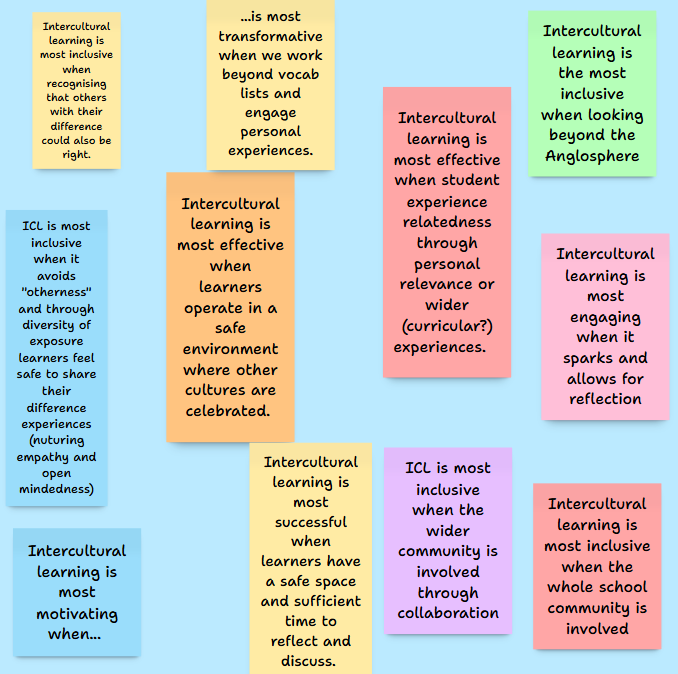
One of the most powerful reflections from teachers in the event was that intercultural projects are not simply “add-ons” to language curricula—they are vehicles for rethinking what language learning is for and the potential it has for broader changes.
As one participant noted during group reflection, these projects are not “decorative” but fundamentally about integration and engagement beyond the GCSE curriculum.
For schools, the challenge is clear: to design projects that do more than increase students’ participation, they should help young people reflect on themselves, understand others, and participate meaningfully in a shared world.
When intercultural learning is designed well, language classrooms become spaces not just for learning words, but for building connections, identities and futures.
A series of creative outputs from these and other NPPs will be available via the LEO platform for teachers to view and replicate after the projects’ end in March 2027.
We recommend joining the NCLE mailing list to be informed about these and other CPD opportunities of interest to Language Teachers.